Showing posts with label Research Investigation. Show all posts

Tuesday, 25 April 2017

Methods for Analysing Media Representations


While students may have an intuitive sense of how the media represents certain phenomena, they need to learn some particular research techniques for how to analyze these representations. It is often useful to model these different techniques, demonstrating how you use them in analysis of a particular example.

The following are some steps involved in conducting studies, following by specific aspects associated with analysing representations:
  • Select a specific group, topic, issue, or phenomenon, and then discuss different representations of this topic/phenomenon in your texts.
  • Note patterns in these representations in terms of similarities in portrayals/images instances of stereotyping or normalising categories.
  • Note value assumptions in terms of who has power, who solves problems, how problems are solved.

Define the intended audiences for these representations:
  • What messages are conveyed to what audiences?
  • Whose beliefs or values are being reinforced or validated?
  • How are certain products linked to certain representations for certain audiences?

Define what’s missing or left out of the representation:
  • What complexities or differences are not discussed?
  • What is included and what is excluded?

Find alternative or counter-examples (this way you construct an argument)

Consider the potential consequences of stereotyped representations of gender, class, race, or age on people and the way they behave

List descriptions of others or oneself and note instances of stereotyping (how have values been altered)

Note how consumer practices reflect the need to live up to representations (aspirations)

In analysing representations, students can focus on the following aspects:

Images. The images employed that reflect certain positive versus negative value orientations based on cultural codes and archetypal meanings, for example, uses of dark or black colors to portray an urban area as dangerous or threatening (Lacey, 1998). In this semiotic analysis of representation, students are examining how the meaning of images as signifiers (wearing jeans vs. suits) creates certain signified or implied meanings (casualness/formality/dress for success).  (Cullin-Swan, B., & Manning, P. K., “Codes, Chronotypes, and Everyday Objects” )

These codes are culturally constituted. Stuart Hall (1997) cites the example of the meaning of traffic lights—the fact that the signified meanings of red and green are culturally determined based on a code system that indicates that in certain cultures, red means “stop” and green means “go.” The difference between red and green is what signifies the meaning based on the cultural code. To determine how images are representing a social or cultural world, you need to determine the code system underlying the media texts.

Sound/music. Media texts represent social worlds through the uses of sound or music. They may represent certain regions of the world by using music associated with those worlds, for example, Samba or Calypso music to represent South American worlds. These uses of sound or music are often based on audience’s prior knowledge of certain types of music as associated with certain types of experiences or worlds.

Intertextuality. Media representations also depend on audiences’ knowledge of intertextual links between the current texts and other previous texts using the same images, language, sounds, or logos. For example, understanding the Energizer Bunny battery ads, in which the Energizer Bunny suddenly appears at the end of an ad, requires a prior understanding of previous Energizer Bunny ads. Audiences understand the meaning of certain representations because they have knowledge of these intertextual lnks. They enjoy fact that they are “in the know” about the intertextual references being made. In analyzing media representations, you therefore need to determine the intertextual links being employed to previous texts, and how these links are being used to represent a world in a certain manner.

Dan Chandler’s discussion of intertextuality

Gunhild Agger, Aalborg University, Intertextuality Revisited: Dialogues and Negotiations in Media Studies

Language. In studying how language is used to represent experience, you are studying how language actually serves to create realities or worlds. The idealized language of advertising is used to create worlds in which flaws or problems are instantly dealt with or solved. The language of sports commentary is used to dramatize the significance of a game to keep viewers watching the game.

In defining these debates, you are also determining how audiences are being positioned to accept certain representations as “normal” or “common sense” constructions of reality. You may then describe how you are being positioned by these debates by asking the question: “What does this text want you to be or think?”

For more click here
 

Saturday, 15 October 2016

Scoop.it Resource Page


We have now set up a Scoop.it Resource page, that can be found in the right hand column, to blog any sites that may be of use for your A2 Media 'Research Investigation'.

This will also contain extra features and sources for the key texts.    

Common 'Research Investigation' Faults

  • Make sure you use quotes/statistics from your research
  • Make sure your research is from a wide variety of sources
  • Make sure you research the theory (include sources in Bibliography)
  • Make sure you apply the theory (use key quotes to support your points)
  • Analyse sequences from your texts to apply the theories in depth (don't generalise across a whole film/programme/CD etc be detailed and be specific)
  • Reference all sources of information in the 'Investigation' & Bibliography
  • Texts should be items (1) and (2) in the Bibliography
  • Use media terminology throughout (remember this is A2)
  • You have probably chosen an issue/topic because you know it exists or is valid - it needs to be remembered though that if you can't prove this through research, your viewpoint has no validity
If you look over your work and can't see evidence that you have covered the above, it is likely that your mark will be low. If you're still unsure then ask for help and guidance. The completed 'Research Investigation' (final draft) needs to submitted before we break for Christmas.

Friday, 14 October 2016

Further 'Research Investigation' Advice


Research Investigation Advice:

• In your introduction you should provide a thesis statement* which refers to the point(s) in the question, answering the question in this opening paragraph, if possible.

• You should progress (develop) your argument by building on key points from paragraph to paragraph. Directly referring to key aspects of the text in detail.

• Signpost new paragraphs clearly by leaving a line gap or indenting. You do not have to do both. Also, don’t be tempted to start a new line just because you are beginning a new sentence.

• Don’t digress: each of your paragraphs should be focused on the topic of the question. Use actual wording from the question from time to time so that you don’t go off the point.

• Be logical: if you are deconstructing an advert, film sequence or narrative, discuss it in chronological order; focus on what happens at the beginning, then the middle, then the end.

• Use key arguments to make your points fluently and clearly. Phrases and connectives help you to make sense when discussing points in a text or linking ideas in and between paragraphs.

These will also help the reader to ‘navigate’ your essay. For example:

At the beginning of the film…
At the start of…
At first / firstly…

Later on in the text…
Further on…
Next we see…
Subsequent scenes…
Secondly…

As stated by....
An opposing argument suggests that....
Fans have stated that .....  "insert quote"
In terms of the uses & gratifications theory this means that.....
Reviews state that ...."insert quote"

At the end of the advert…
As the text draws to a close…
In conclusion / To conclude
Finally / My final point is…

Similarly / Likewise
In addition / additionally
Furthermore
Moreover
As well as this

However
Whereas
Whilst
Although
Even though

As a result
Due to (the fact that)
Since / Because
Consequently / As a consequence
Subsequently

• Use the media terminology as a tool – to help you discuss the texts.

• Make sure you reference all quotes, theory and information thoroughly throughout your essay. Indent any quotations that are longer than 2 lines.

• Always write a conclusion by referring back to the main point(s) in the question.

• And finally, above all…if you are unsure of something, or uncertain about what you want to write, don’t write it. Keep your points simple in this case, and don’t try to use vocabulary that you don’t understand.

* A thesis statement is the statement that begins a formal essay or argument, or that describes the central argument of your discussion.

Sample: Question/Opening Paragraph/Bibliography


To make sure that your Research Investigation includes referencing and a clear bibliography here are some sample extracts to use as a  guide. (they are all from different projects)

Sample Question/First Paragraph

How are women represented in contemporary advertisements, paying particular attention to Tom Ford and Dior campaigns?

The representation of women differs significantly within advertising, and through various theories, I will explore this. Different aspirations are exposed to the public life influencing how women should act or how they are supposed to be viewed in reality. The two adverts that I am analysing represent women in two completely different ways, in Tom Fords advertisement women are shown in a very controversial and objectified way to sell their product to their target audience, who are mainly men. In Dior’s advertisement women transmit an image as wealthy and inspirational, which prominent ideology which is influential to women to buy their product. I will be applying specific theories such as Laura Mulvey’s  theory of 'the male gaze' and possibly the objectification of women and their stereotypical gender roles. Also I will explore the Hypodermic Model, paying particular attention to advertising campaigns such as Tom Ford’s “Ford for Men” [2] and Dior’s “Miss Dior Cherie” advertisements. [1] (see appendix [1] and [2]) 

Sample Paragraph

In ‘Lara Croft: Tomb Raider’ (1) directed by Simon West, there is a strong female protagonist; the film is based on the adventures of an archaeologist originally depicted in a series of video games, which gave teenage boys the power to control a beautiful woman and alter camera shots which depicted her. Croft’s character is described as “a beautiful, intelligent and athletic archaeologist-adventurer” (13). There is a clear differentiation from ‘Alien’ (2) here, as Ripley’s character was originally written as a man, the character of Lara Croft is most definitely a woman and this is clearly demonstrated throughout the film; in particular the fact that Croft is supposed to be seen as a powerful but sexualised woman is demonstrated through the use of camera angles. “Lara is super strong, invincibly strong. But also stunningly beautiful, unbelievably beautiful. This combination has characterised film heroines since the 1990s.” (14) Within ‘Tomb Raider’ (1) a large number of camera shots focus on Croft’s chest and thighs- this is where her guns are strapped so every time she uses them the camera focuses here. An example would be in the opening scenes of the film in which Croft fights a robot in a training scene, there is a five second close-up shot of Croft’s thighs. This objectifying of the character is clearly shown on advertising for the film. (Appendix 2) Laura Mulvey’s Theory of the Male Gaze, suggests some “films objectify women in relation to ‘the controlling male gaze’, presenting ‘woman as image’ (or ‘spectacle’) and man as ‘bearer of the look’. Men do the looking; women are there to be looked at.” (5) This would suggest that the character of Croft is simply there for male pleasure rather than alter gender stereotypes; demonstrated in the opening fight scene in which the camera focuses on her breasts, legs and bottom, Croft is noticeably portrayed as a sex symbol.

Sample Bibliography

Bibliography

[1] The Black Swan (2010)

[2] The Kings Speech (2010)


[6] MediaMagazine 6th December 2003
‘Entertaining madness-representations of mental illness on screen’


[8] Oxford Dictionary

MS3 - Research Investigation

Structure of essay:

  • Introduction - What you intend to research and how? What theories you intend to use?
  • Textual analysis - What you are investigating in your texts. What is revealed. Points of discussion should relate to detailed analysis.
  • Applying theory - Theoretical approaches need to be applied to reveal similarities and differences. Important discussion points and development of argument.
  • Reference to research - Research should support argument and points of your discussion. Referencing should be explicit and related to your bibliography.
  • Logical flow to essay - The essay should develop the argument in a logical way.
  • Conclusion - Main points of the essay should be pulled together in the conclusion to round off your argument. Don't add new points at this stage.

Wednesday, 12 October 2016

Research investigations - Miss representation quotes

The following quotations come from the documentary entitled “Miss representation” (this can now be viewed on Netflix) and deal with issues of false and bias female representations in the Media, which help contribute to a patriarchal society.  Some are statistics the documentary presents via on screen graphics where others are specific quotations from contributors.


  1. ·      Teenagers on average, spend 10 hours 45 minutes a day consuming Media
  2. ·      Girls learn from a very early age, the most important thing is how they look
  3. ·      53% of 13 year old girls are unhappy with their bodies, by 17 the statistic is 78%
  4. ·      Rates of depression among girls and woman have doubled between 2000 and 2010
  5. ·      The ideal image of beauty is becoming more extreme and impossible than ever before – Jean Kilbourne
  6. ·      Girls measure themselves against an impossible standard and end up feeling left wanting
  7. ·      The non content form of the media has to be backed up and supported by the content
  8. ·      A lot of advertising is based on making people feel anxious and insecure – Jean Kilbourne
  9. ·      Girls learn to see themselves as objects– Jean Kilbourne
  10. ·      American woman spend between 12-15 thousand dollars a year on beauty products
  11. ·      The number of cosmetic surgery procedures performed on youth under 19 more than tripled from 1997 to 2007
  12. ·      At 7 years old little girls and little boys want to be president of the United States in equal number, 30%, ask the same question at 15 and a huge gap has occurred – Caroline Heldman
  13. ·      In areas where females have challenged male power, males have responded by representing them in a way that assists in taking their power away – Jackson Katz
  14. ·      Congress has the fewest amount of woman in 30 years
  15. ·      Females own 5.8% of all TV and 6% of radio
  16. ·      97% of publishing companies are owned by Males
  17. ·      Woman comprise only 16% of all writers, directors, producers, cinematographers and editors
  18. ·      10% of writers of film are female
  19. ·      People tend to employ reflections of themselves – Lindy Dekoven
  20. ·      We replicate the world we grow up in – Film Director
  21. ·      The representation of females in film has become much more narrow and cartoon like than in the 20s, 30s, 40s and 50s
  22. ·      In the 1990’s studies found a steady increase in explicitly sexual images in advertising
  23. ·      The exploitation of female bodies sell products
  24. ·      Males are taught to not express emotion
  25. ·      Females are represented as young
  26. ·      You  cant be what you cant see
  27. ·      Females are not represent in the Media for doing something, they are represented for how they look
  28. ·      Many woman are empowered, but not represented in the Media
  29. ·      The majority of females on TV are between 20-30, 71%
  30. ·      39% of woman in the world are under 30
  31. ·      Woman are represented as natural enemies of woman
  32. ·      The Male Media represents females in power trivially, often concentrating on appearance, which influences audience’s opinions of females in power
  33. ·      Females are represented as emotional and irrational
  34. ·      Only 16% of protagonists in film are female
  35. ·      In between 1937 and 2005, there was only 13 protagonists in animated movies who were female. All apart from one of them had the aspiration to find romance – Greena Davis
  36. ·      As a culture woman are brought up to be fundamentally insecure
  37. ·      Were socializing boys to believe being a man is being in charge and dominate – Jackson Katz
  38. ·      More than 20% of teens have sex before the age of 14

Saturday, 10 October 2015

Sample 'Research Investigation' (Edited)


With specific reference to 'Kidulthood' and 'Angus Thongs and Perfect Snogging', How are teens represented in social realism in comparison to a teen Film genre?
In my investigation I will be looking at two very different genres, which represent teenagers in dramatically different ways. In my investigation I will be researching social realism and the typical teen movie, I will establish which one represents reality and whether either have negative effects on teenagers life’s today, referencing Kidulthood[1] and Angus Thongs and Perfect Snogging[2].I will be researching information through the Internet using different websites, and using books to collect other information. …………….………………………………………………………………………………………………………….

Social realism, ‘the most ‘typically British’ of all film genre’s, better than any other genre, social realism has shown us to ourselves, pushing the boundaries in the effort to put the experiences of real Britons on the screen, and shaping our ideas of what British cinema can be’ [11]. Social realist texts draw in characters that inhabit the social margins of society in terms of status and power. [16] The genre consists of factory workers, office underlings, dissatisfied wives, pregnant girlfriends, runaways, the marginalised, poor and depressed; typically, films within the social realist genre are gritty, urban dramas about the struggle to survive the daily grind. [19] KH is all about harsh reality. One of the main problems in KH occurs when Alisa one of the main characters finds out she’s pregnant. This is just one of the problems in Social Realist texts. Her best friend, Becky doesn’t really care or bother about the fact Alisa’s pregnant and just thinks it gets in the way, as Alisa doesn’t want to go out as much. KH is based in a mixed-income area of West London [12] and most people struggle with day to day life [8].

Teen film is a film genre targeted at teenagers and young adults where the plot is based upon the special interests of teenagers such as coming of age, first love, rebellion, conflict with parents, teen angst, and alienation. [10] Teen films are popular all over the world; they are not just a Hollywood genre. [13] ATPS is based around ‘first love’ and ‘conflict between parents’ two special interests of a teen film. Georgia the main character does everything she can to try and get with a ‘hottie’ at their school, Robbie who has just moved to Eastbourne from London. …………………..

Near the start of KH, Trife finds out Alisa’s pregnant due to a phone call as their year has the day off because Katie, a girl also in there year is being physically and emotionally bullied by a group of girls led by Shaneek, and is separately threatened by Sam. Her parents do not know the extent of the bullying. After being picked up from school, a distraught Katie flees to her bedroom, writes a note, and hangs herself. [12] Trife, and his mate Jay, are waiting for Mooney to get to Trife’s to go out and do something with their day off they have. Mooney is trying to hitch a taxi form the side of the road, but it’s looking impossible. This could be due to the way he’s appearance, as people might come across that he is a Chav, this could be because of his clothes and the language he is using. ‘’Taxi.. What the fuck man!?’’ [1] Chav’s are said to be aggressive and arrogant teenagers and young adults, of underclass background who repeatedly engage in anti social behavior such as street drinking, drug abuse and rowdiness, or other forms of juvenile delinquency. [15] This representation is a stereotype - “a fixed, over generalised belief about a particular group or class of people.” The use of stereotypes is a major way in which we simplify our social world; since they reduce the amount of processing (i.e. thinking) we have to do when we meet a new person. [21] A ‘Chav’ is an example of a stereotype, by stereotyping we infer that a person has a whole range of characteristics and abilities that we assume all members of that group have. Stereotypes lead to social categorisation, which is one of the reasons for prejudice attitudes (i.e. “them” and “us” mentality), which leads to in-groups and out-groups. [21] This is a disadvantage as it makes society ignore differences between individuals; therefore we make generalisations about people that might not be true [21] The Taxi drivers are stereotyping Mooney as a ‘Chav’ by the way he looks, and ignoring the fact he could be a nice lad behind his trackies and language. Social realism is again showing us an experience, which happens in day-to-day life, but teen film ignores the realism completely.
……………………...
Teen pregnancy’s increases every year due to teenagers having unprotected sex. The increased sexual activity among adolescents is manifested in increased teenage pregnancies and an increase in sexually transmitted diseases. [17] In KH, it deals directly with issues such as pregnancy, sex and drugs. Alisa finds out she’s pregnant, she’s only 15. Trife’s the dad, but doesn’t realise how important this is and the consequences he could have, due to his young age of becoming a dad, and just carry’s on playing his game with Jay. This shows that social realism films use real social issues that are going on in people households in this low income area, where as in the teen film ATPS, it revolves around the more superficial act of a first kiss. …………………………...

Coming from a poor background, the girls have no money to their name, so Becky takes Alisa to an older man's house where they perform sexual acts in return for drugs. Becky is the instigator and Alisa feels that she has to follow her friend's actions. [12] Thanks to the relaxation of censorship, characters had sex lives, money worries, social problems. British 'auteurs' like Karel Reisz, Tony Richardson and John Schlesinger dealt with prostitution, abortion, homosexuality, alienation and relationship problems.[11]

Teen films are often set in or around high schools as this allows for many different social cliques to be shown. [10] British Social Realism films are filmed on actual, real life locations such as parks and council estates and not in made up sets in studios like mainstream Hollywood films use. [18] ATPS is set in a high school to show the comparison between the different teenagers at the school. Georgia and her friends are not as popular compared to ‘slaggy Lindsey’ who is hitting on Robbie one of the new brothers who moved from London to Eastbourne. ………………………………………………..

Family dysfunction can be any condition that interferes with healthy family functioning. Most families have some periods of time where functioning is impaired by stressful circumstances (death in the family, a parent's serious illness, etc.). Healthy families tend to return to normal functioning after the crisis passes. In dysfunctional families, however, problems tend to be chronic and children do not consistently get their needs met. Negative patterns of parental behavior tend to be dominant in their children's lives. [20] In the park scene of ATPS, ……………………………. middle class environment, so they have more support if they come from a broken home and will have less dysfunction throughout there lives. KH are also shaped through their working class environment, they have less support coming from a dysfunctional family, this then leads them into drugs, violence and rebelling, and there lives will be full of more dysfunction throughout.

Bibliography
[1] Kidulthood (2006) Directed by Menhaj Huda (KH)
[2] Angus Thongs and Perfect Snogging (2008) Directed by GurinderChadha (ATPS)
[8] http://www.kidulthood.co.uk/
[11] http://www.screenonline.org.uk/film/id/1037898
[13] http://www.talkingpix.co.uk/ArticleTeenSpeak.html
[18] http://www.slideshare.net/hannahmedia123/codes-and-conventions-of-british-social-realism
[20] http://www.k-state.edu/counseling/topics/relationships/dysfunc.html
[21] http://www.simplypsychology.org/katz-braly.html
[23] http://www.urbandictionary.com/define.php?term=snogging

Friday, 28 November 2014

Media Investigation tips (getting started)


Research Investigation: Grade Criteria/Boundaries


Here is a guide to the marking criteria for the 'Research Investigation'. You should notice that the marks are generated by:
  • The quality of your Research
  • The range of material sourced
  • Your ability to apply your research to your texts
  •  The ability to analyse your texts
  •  The ability to present the results in a clear and structured argument 
  •  Accuracy of written communication  
Note: Grade boundaries can be altered due to National averages

Tuesday, 7 October 2014

Essential Media Language: 'Research Investigation'


MS3 - Research Investigation Sample (Extract)


"To what extent do television transformation programmes influence their audience?"

I will be analysing the representation of women’s body image and the ideologies of what is seen to be “beautiful”, using research and my investigation, in particular reference to the two channel 4 programmes “How To Look Good Naked” and “10 Years Younger” to establish; to what extent these programmes have an impact on our society and how influential they are within their audiences.

Psychological research has shown that ‘body image’ ultimately does play a part in the lives of women yet there is an increasing trend of this effect in teenagers also. This viewpoint has been supported in a number of studies are suggests that: Teen-age girls who viewed commercials depicting women who modeled the unrealistically thin-ideal type of beauty caused adolescent girls to feel less confident, angrier, and more dissatisfied with their weight and appearance (Hargreaves, 2002). (1) Undoubtedly, this type of media has an effect on a women’s body image, it is an everyday occurrence and taken for granted, yet sadly today it is worrying as women have become more obsessed, unhappy and increasingly more depressed about their body hang ups.

The Channel 4 programme “How To Look Good Naked” usually consists of a woman who has hit rock bottom in terms of her body image and self esteem then, with the assistance of Gok, she experiences a series of events which result in a new contented and confident woman “Gok Wan presents the inspirational fashion series that shows women how to look fantastic with their clothes on or clothes off no matter what their body shape - and all without a surgeon's scalpel in sight...” (2) This reinforces a positive representation of women and an acceptable message being portrayed, in effect encouraging a passive response to self-awareness. It inverts the stereotypical viewpoint that thin constitutes beauty, as the show illuminates every aspect of the natural woman, they way they really are, bumps and lumps and all, and embraces it rather than dictating the way they should be, or the way they could change something to look better, it focuses on making the most of what you’ve got and being thankful for it. In this respect it a good example of TV programming that does not make it’s passive audience feel inferior or inadequate.

I looked closely at the episode of season 3 episode 15 featuring a woman called Kelly; she had been through breast cancer and as a result of treatment was left with only one breast. She has been planning to get married but is so low in terms of self esteem she can’t bring herself even try on a wedding dress. The presenter is Gok Wan stylist to the stars, Takes Kelly to a wedding fare and uses language like“I’ve got to prove to Kelly she will be a Babylicious bride “(3) By just using the word “prove” this directly suggests that she already is beautiful she just needs help seeing it, which ideally is the whole message of the show. He is kind and encouraging and never judgmental, preferring to apply more positive manipulation of a passive audience rather than a negative. Focusing on every good aspects of the woman whether it be their killer legs or fantastic breasts boosting their self believe in the hope of erasing the idealization that seems to have been mediated into their minds. People with a preferred reading of the show would really identify with it on a personal level and may be even try to incorporate these qualities into their lives and from this personal level they get a gratification from it like a companionship from Gok. Also this may encourage a comparable reaction within peer groups who pass the information from friend to friend. Similarly I take a hegemonic approach but rather than passively and excepting its codes I can actively see the deeper message the programme is trying to portray.

By using statements like; “she is going to be the most gorgeous blushing bride!”(4) and going through little things like a line up of women that also had breast cancer, reinforces a positive attitude to self empowerment. Kelly gradually builds her self esteem bit by bit changing , from using statements like “I look horrible” (5) to “she said I had a beautiful face, how does that feel ?, that feels lovely… I look nice don’t I, really girly and sexy” (6) inevitably there is a transformation, not physically yet mentally, because she was fine the way she was. Active audiences may also see that even though there is manipulation it is not at a superficial level but more psychological and therefore more likely to last.

* This is a partial extract of a Research Investigation and should only be regarded as a guide.

Research investigation guidance

Research investigation - first draft advice

Wednesday, 2 April 2014

MS3 - Evaluation: Guidance


  • Refer to your 'Research Investigation' and how it has informed your production choices - Within my Research Investigation I examined ........ and the issue of........I discovered that.......
  • Show an awareness of your audience needs - mode of address/age/gender/representation etc - what form? (teaser poster/full promo poster/CD cover/Magazine/trailer)
  • Use media language throughout - genre/conventions/representations/image/connotation/mode of address/masthead/colour palette/enigma codes
  • Refer to media theory when applicable - Mulvey/Uses & Grats/audience gratification/representation
  • Highlight key strengths of the production
  • Highlight any weaknesses of the production
  • Refer to, describe and make direct statements concerning your production texts
  • Include images of your production texts within your evaluation (750 words)

Thursday, 7 November 2013

The evolution of fairytale heroines in film


Representation

Today's screen princesses have come a long way from the Disney damsels of old, but Joan of Arc still sets the bar high.

It's been a great year for warrior princesses at the movies – even better if they come bearing bow and arrows. First we had Katniss Everdeen, as incarnated in the svelte, fearless form of Jennifer Lawrence, eyes narrowing as she strung her bow and sent The Hunger Games $672m into the black.

Katniss was followed by Snow White, as played by sullen beauty Kristen Stewart, her sword slicing the air to save the kingdom of her late father and topple The Avengers from the top spot at the box office. And now we have Pixar's Brave, boasting the studio's first female heroine, flame–haired, cinch-waisted Princess Merida, "dear and bonny and lovable, the face beautiful, and transfigured with the light of that lustrous intellect and the fires of that unquenchable spirit".


So wrote Marc Twain of Joan of Arc but he could as easily have been describing the new breed of warrior princess riding, fighting, shooting, scything their way across our screens. As Sasha Stone commented at Awards Daily, "it's hard not to look at 2012 and not declare it the Year of the Girl". Although these feisty female role models have not met with universal approval. Merida could have used "a few more pixels in her waist", complained Peggy Orenstein, author of Cindarella Ate My Daughters: Dispatches From the Front Line of the New Girly-Girl Culture. "Merida doesn't really grow," pointed out Mary Pols in Time, "She's simply extended her time as a tomboy, another archetype, less a girl than a stereotype of a kind of girl."

Certainly, Disney princesses have been ploughing the feisty furrow for some time, at least since Princess Jasmine ran away from home rather than be married off at her father's behest in 1992's Aladdin. Jasmine, Pocohontas and Mulan were all touted, in their time, as "new", "empowered" Disney heroines who refused to sit at home plaiting their hair waiting for their prince to come. Clearly, some stereotypes are better than others, although even calling "stereotypes" in a Hollywood movie is a fraught activity, given that the semantic overlap between that and what most screenwriters would call "characterization". Either way, we have come a long way from the days when Snow White could arrive at the seven dwarves' home and immediately start house-cleaning without a word of complaint.

In a study conducted at the University of Connecticut, Dawn England and Lara Descartes divvied up the screen time of all eight Disney Princess into three categories: "domestic work", "interacting with animals", and "other". They reached the following conclusions:
"Princesses performing domestic work was only portrayed in the first three princess movies and again briefly in Pocohontas. However in the first two movies it occupied a significant amount of time. Time spent interacting with animals was very prevalent in the first four movies decreased slightly in the next three, and then significantly increased in Mulan."
In Pocohontas' defence, it should be pointed out that teepees get messy very quickly without regular housecleaning, and that Mulan was accompanied throughout much of the film by a red-and-orange Chinese dragon voiced by Eddie Murphy, who is better better classified under "comic relief", perhaps, than "interacting with animals". But no matter – onto the princes, whom they scored for personality traits ranging from "assertive" to "troublesome" then comparing them with the princesses' scores:
"The princesses were significantly more likely to be cooperative, nurturing, tending to their physical appearance, and troublesome. While the princesses were not likely to be portrayed as physically strong, unemotional, or inspiring fear, these characteristics were more common among the princes. The princes were least likely to tend to their physical appearance."
(Here Brave scores very highly, some of its strongest jokes coming at the expense of the young Scottish lords all vying for Merida's hand – a rogue's gallery of narcissists, boneheads and tennis-pro preeners.)
"The princes were action-oriented, often performing the climactic rescue that brought the conclusion of the movie. Over time the princesses' roles changed form being completely passive or asleep during the final rescue to assisting the princes."
"Asleep" seems a little harsh on Sleeping Beauty – the poor girl had hardly nodded off – but perhaps the most surprising observation was this:
"Among the princesses, assertiveness was more common in earlier films and fearfulness and tentativeness were depicted more often in later films."
Huh. The modern princesses are more fearful and less assertive than their predecessors. And yet, at the same time, they lead the action more and need rescuing less. What's that about? After much mulling on the matter, it occurred to me that this might be a side effect of greater psychological verisimilitude coupled with the old Hemingway paradox about the brave man not being the man without fear but the man who feels fear and still acts. The princesses are showing more fear because they were doing more.


It certainly explains why these films have been such hits, even with boys. Female protagonists means greater asymmetry of battle (they are outmatched) means greater suspense (they could lose) means bigger thrills (they must keep their wits about them). Snow White and the Huntsman boasted enough swords, scimitars, axes, and snares to keep a horde of Hobbits busy for a month of Sundays, drawing the admiration of none other than James Franco who chivalrously defended Stewart's performance from its detractors, "she has worked her ass off. Whatever Snow White may be, Kristen is a warrior queen. Give her the crown." Or, as Twain said:
"Supremely great souls are never lodged in gross bodies. No brawn, no muscle, could endure the work that their bodies must do; they do their miracles by the spirit, which has fifty times the strength and staying power of brawn and muscle. The Napoleons are little, not big; and they work twenty hours in the twenty-four, and come up fresh, while the big soldiers with the little hearts faint around them with fatigue. We know what Joan of Arc was like without asking– merely by what she did. The artist should paint her spirit – then he could not fail to paint her body aright."
guardian.co.uk: 29/6/12 

'The Perfume Ad Formula' @ Visual Culture Blog

Click image to access
Extract:

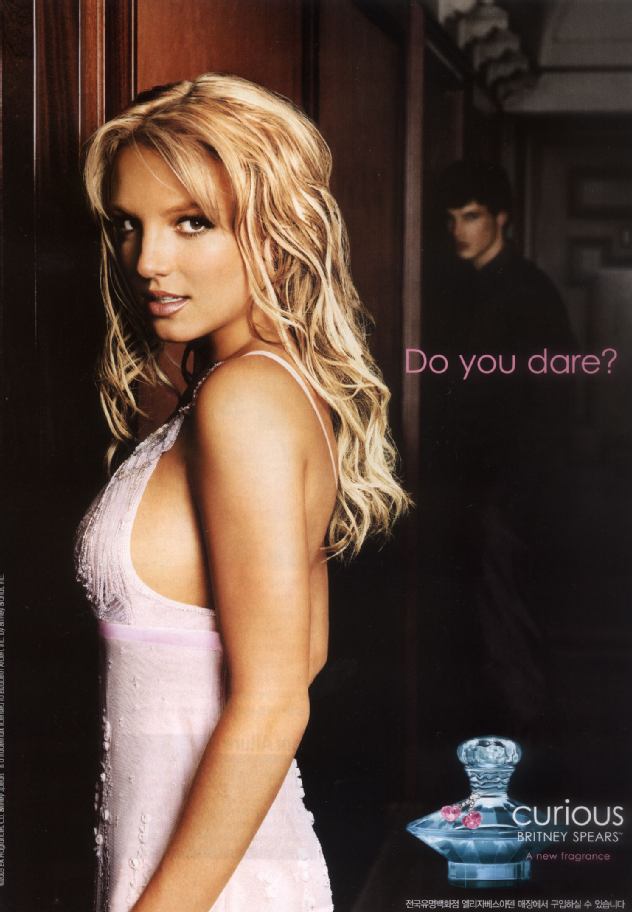
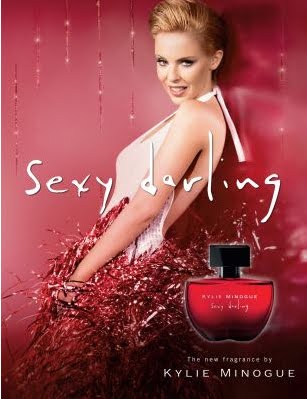
Another theme explored in the perfume ad formula is the celebrity returning a gaze back to the spectator over her left shoulder. The pose is strongly suggestive of photographs taken on the red carpet in which the celebrities twist and turn to present their dresses to the assembled photographers. While Kylie Minogue is simply referred to as ‘Sexy Darling’, this emphasis on exhibitionism and a visual encounter with the celebrity is further stressed in Britney Spears’ ad for Curious. A man can be seen in the background to the photograph looking at Spears, while Spears herself is suggestively looking at the spectator. The slogan ‘Do you dare?’ further underlines a sexual element to the representation of gender, as if the spectator is invited to join the subjects into a hypothetical ménage à trois via the gaze.


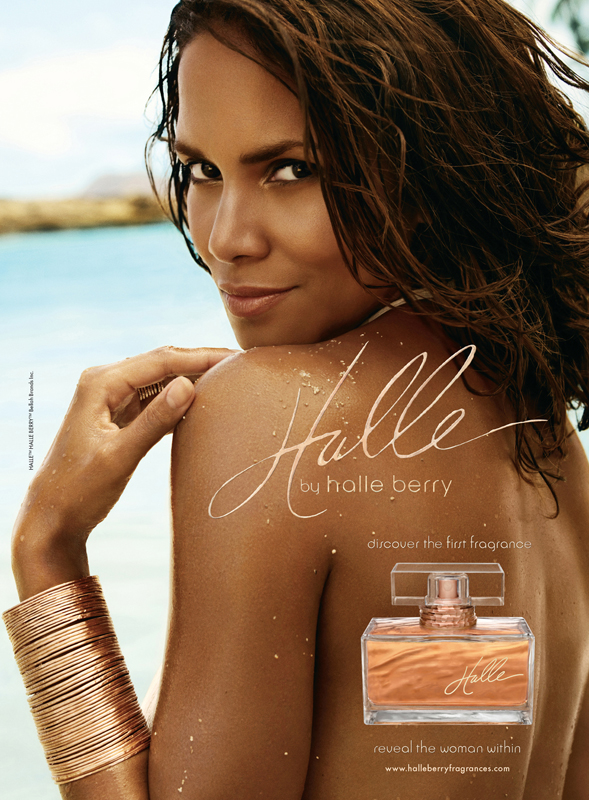
Halle by Halle Berry and Eva by Eva Longoria also submit to the perfume ad formula of celebrity returning a gaze back to the spectator over the left shoulder. In both cases, the name of the perfume is the first name of the celebrity herself, whereas the name is written in such a way that it looks like the celebrities’ signature. This is an important element in the ad since, as it appears, the perfume is not only endorsed by the celebrity, but rather, it’s created by the celebrity herself. Like the artist signing his artwork, the celebrity signs her creation. I am using the word sign in the semiotic sense – the sign as a signifier. Here the signature signifies the celebrity’s assumed personal affiliation, even creation, of the perfume.